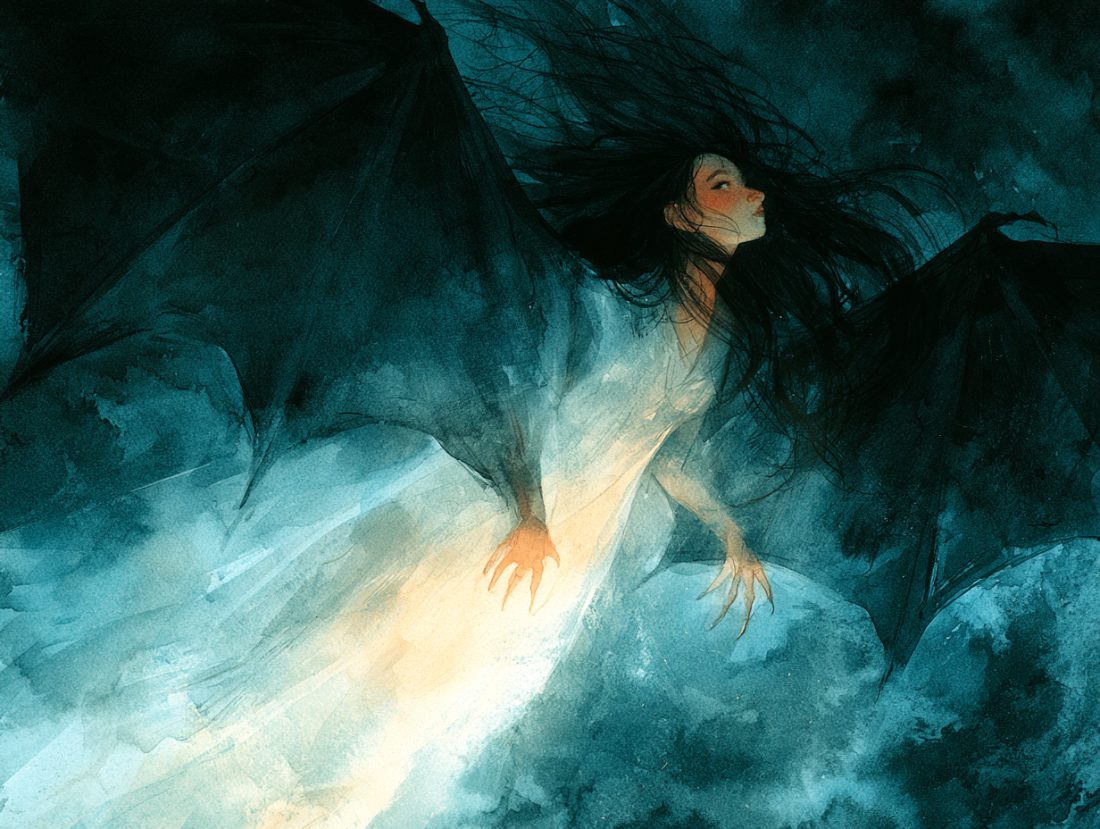
She doesn't just transform. She comes apart.
The Manananggal is one of the Philippines' most unsettling creatures. After dark, her torso splits from her legs, bat-like wings unfold from her back, and the upper half flies into the night, leaving the legs standing upright somewhere out of sight. The name comes from tanggal — Tagalog for "to separate" or "to remove."
Field Notes
- Known for: separating at the torso and taking flight after dark
- Feeds on: traditionally, sleeping pregnant women, reached at a distance by a long, thread-like tongue — some versions describe it feeding on the sick or dying instead
- Where it lurks: Capiz, in the Western Visayas, which carries a long-standing reputation as the Philippines' "witch capital" largely because of her
- How to stop it: rub salt, crushed garlic, or ash into the abandoned lower torso, or lay a stingray's tail (buntot pagi) across it — the two halves can't rejoin before sunrise, which is fatal to it
In Tiktik
The Manananggal isn't hunting — she's avoiding. Every night she takes the long way around one particular line she won't cross, adding hours to the trip, unwatched and unthanked. The self-control is the point of the story, not the transformation.
Quick facts
- Name comes from tanggal — "to separate" — describing how it splits at the torso
- Traditionally hunts with an extended, thread-like tongue rather than by direct attack
- Weaknesses: salt, garlic, ash, or a stingray's tail applied to the abandoned lower body
- Most strongly associated with Capiz province in the Western Visayas
- Appears in Book 1, Tiktik: A Summer of Three Names